Documenting Equipment Regulation Updates and Their Influence on Stroke Efficiency Trends Across International Golf Circuits for Prop Market Adjustments
Written by Riley Friedrich · Nov 7, 2026
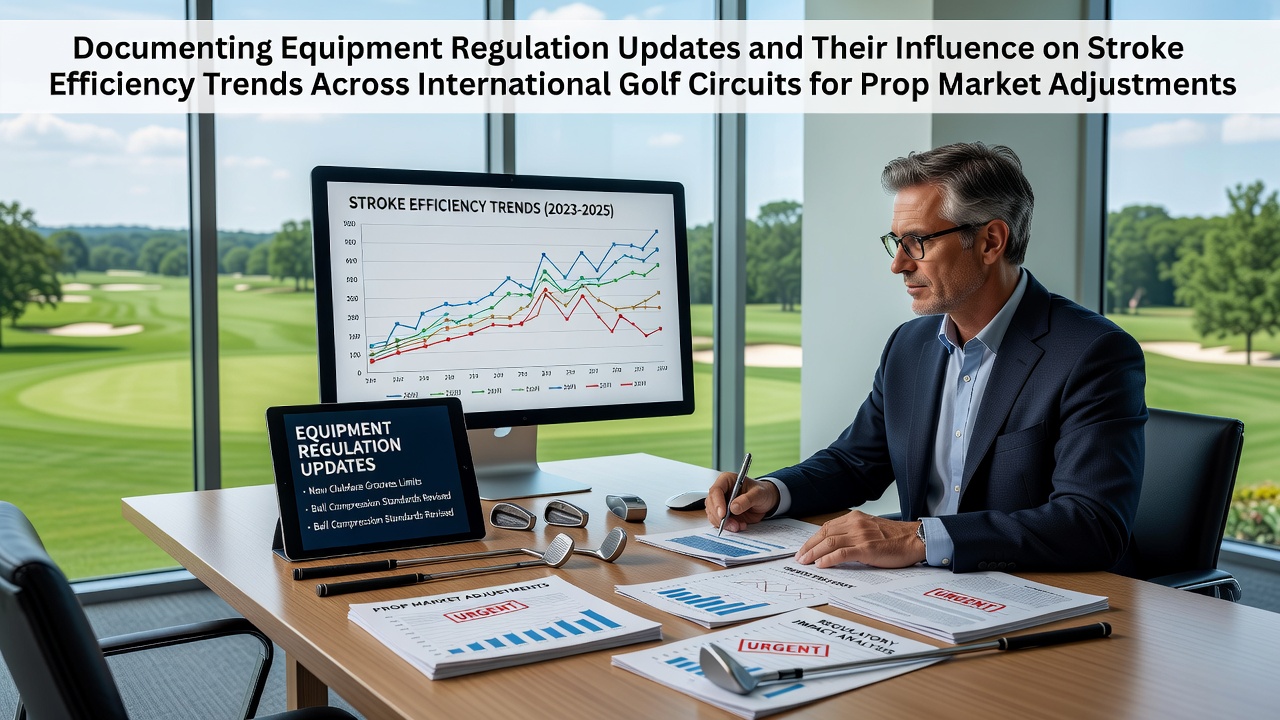
Documenting Equipment Regulation Updates and Their Influence on Stroke Efficiency Trends Across International Golf Circuits for Prop Market Adjustments
Equipment regulation updates in professional golf originate from governing bodies including the United States Golf Association and the R&A, which coordinate standards for clubs and balls across multiple tours. These changes target variables such as club face flexibility, ball construction, and groove patterns, and they produce measurable shifts in stroke efficiency metrics like fairway hit rates, greens in regulation percentages, and average driving distance per swing. Data from the PGA Tour and the DP World Tour indicate that such adjustments alter player performance patterns in ways that directly inform prop market calculations for individual shot outcomes.
Key Equipment Changes and Their Timeline
Regulatory bodies implemented new testing protocols for driver faces in 2022, with additional ball diameter and weight specifications phased in through 2024. Observers note that the next major set of limits on golf ball distance is scheduled for implementation in November 2026, requiring manufacturers to adjust core materials and dimple designs. These updates follow laboratory measurements conducted under controlled conditions at facilities in both the United States and the United Kingdom, and they apply uniformly to events on the PGA Tour, the European circuit, and the Asian Tour.
Stroke efficiency refers to the ratio of successful shots relative to total attempts, and researchers track this through metrics such as strokes gained off the tee and approach play. Studies from performance analysis groups show that reduced ball speed from new constructions leads to shorter carry distances, which in turn increases the number of approach shots required on longer par-four and par-five holes. This pattern appears consistently across venues with varying altitudes and wind conditions.
Impact on Stroke Efficiency Across Circuits
International tours record stroke data through standardized ShotLink-style systems that capture launch angles, spin rates, and dispersion patterns. On the PGA Tour, average driving distance declined by approximately 4.2 yards in the season following the 2022 face flexibility rules, while greens in regulation percentages on par-three holes rose by 1.8 points according to official tour statistics. The DP World Tour reported similar directional changes, although the magnitude varied by course length and grass type. Players who relied on high-launch, low-spin driver setups experienced the largest adjustments in their efficiency numbers, whereas those with controlled fade shots maintained more stable fairway percentages.

Asian Tour events, often played on firmer turf and at higher temperatures, displayed smaller reductions in driving distance yet recorded measurable increases in approach shot accuracy because lower ball speeds reduced roll-out distances on landing areas. Analysts compare these figures against historical baselines to isolate the regulation effect from weather or course setup variables. The resulting datasets feed into models that project prop outcomes such as a player hitting more than 10 fairways or recording under 28 putts in a round.
Prop Market Adjustments and Data Integration
Betting markets that focus on individual performance statistics incorporate stroke efficiency trends by recalibrating expected values after each regulatory shift. Operators track correlations between equipment changes and specific outcomes, including the probability of a player reaching greens in regulation on par-four holes longer than 420 yards. Figures released by tour statisticians and independent performance labs provide the raw inputs for these adjustments, and they appear in public reports updated quarterly.
One documented case involved a 2024 groove regulation clarification that affected wedge spin rates; subsequent data from the European circuit showed a 3.1 percent rise in scrambling percentages from bunkers because players generated more consistent contact. Prop markets responded by tightening lines on related player props for the remainder of that season. Researchers at sports analytics centers in Australia and Canada have published parallel studies confirming that these efficiency shifts persist across different player cohorts when equipment constraints remain constant.
Monitoring and Future Projections
Continuous documentation of regulation updates relies on collaboration between equipment manufacturers, tour officials, and independent testing agencies. Monthly reports compile launch monitor data from multiple continents, allowing analysts to detect early deviations in stroke patterns before they fully manifest in tournament results. The November 2026 ball specification change is expected to extend these trends, particularly on longer layouts where carry distance becomes a limiting factor. Models currently under development integrate wind-adjusted stroke data from the past three seasons to forecast how the new limits will redistribute efficiency rankings among top players on each circuit.
Conclusion
Equipment regulation updates produce quantifiable changes in stroke efficiency that propagate through international golf circuits and inform ongoing prop market recalibrations. Data from the PGA Tour, DP World Tour, and Asian Tour demonstrate consistent directional effects on distance, accuracy, and scrambling metrics following each rule modification. The scheduled November 2026 adjustments will supply additional datasets for analysts to refine projections, and the resulting performance records will continue to support precise statistical modeling across global events.