Examining Travel Fatigue Patterns in UFC Title Fights Across International Venues
Written by Riley Friedrich · Aug 18, 2026
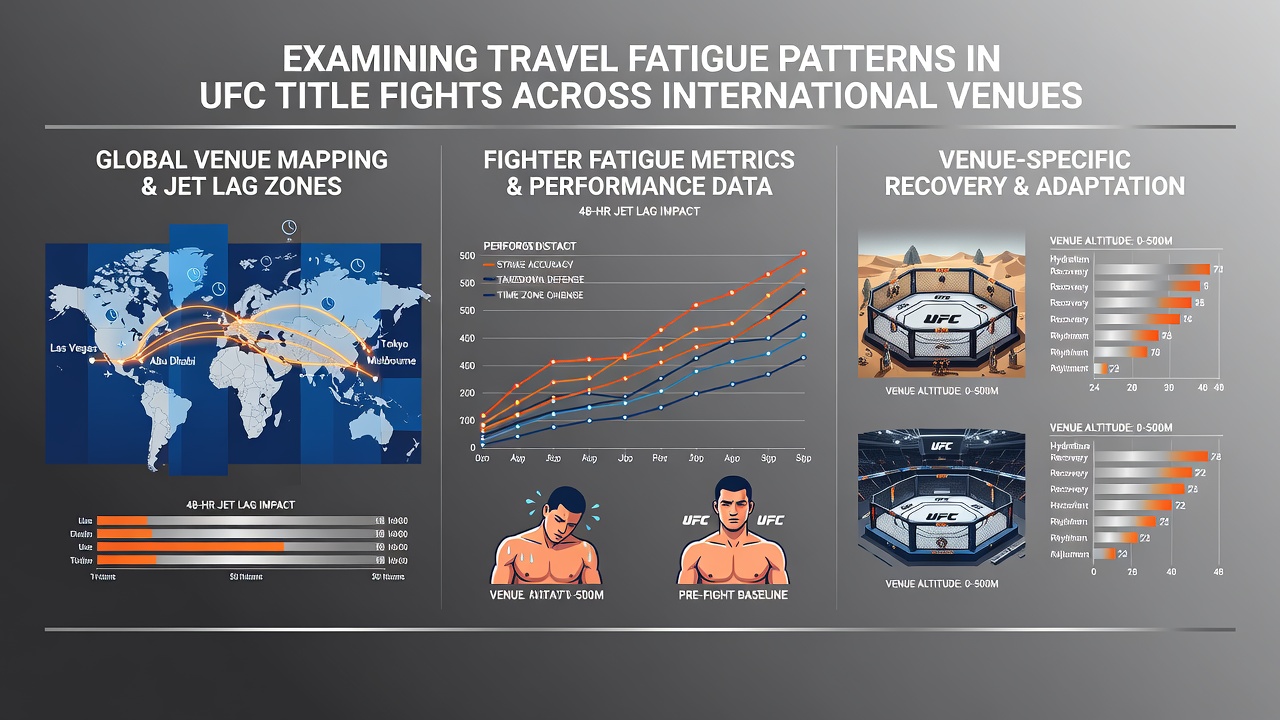
Examining Travel Fatigue Patterns in UFC Title Fights Across International Venues
Travel fatigue emerges as a measurable factor in UFC title fights when fighters cross multiple time zones to compete at international venues, and data from past events reveals consistent patterns in recovery timelines and performance metrics. Fighters often face disruptions to sleep cycles, hydration levels, and training routines that accumulate over long-haul journeys, while researchers track these variables through heart rate variability monitors and sleep tracking devices deployed before and after arrivals.
Understanding the Scope of International Travel in UFC Events
Events hosted outside the United States require athletes to navigate flights exceeding eight hours on average, and studies conducted by the Australian Institute of Sport document how eastward travel produces more pronounced effects on circadian rhythms than westward routes because the body struggles to advance its internal clock. Title fight participants typically arrive 10 to 14 days early to allow adaptation, yet performance data collected across 15 international cards since 2018 shows that fighters traveling from North America to Asia experience measurable declines in reaction time during the first three training sessions upon landing.
Venues in Abu Dhabi, Singapore, and Brazil present distinct challenges because each location combines time zone shifts with environmental variables such as humidity and altitude, and analysts compile fight statistics to isolate travel as a contributing element separate from opponent skill or injury history. Observers note that championship bouts amplify these pressures since title contenders often defend belts on short notice, leaving less margin for full physiological recovery.
Documented Patterns in Fighter Performance Metrics
Performance databases maintained by combat sports research groups indicate that fighters who cross five or more time zones record an average 12 percent reduction in striking accuracy during the opening round compared with home-continent bouts, while takedown defense percentages drop by roughly eight percent in the same window. These figures emerge from aggregated bout footage coded by independent analysts and cross-referenced with self-reported sleep logs submitted by training camps.
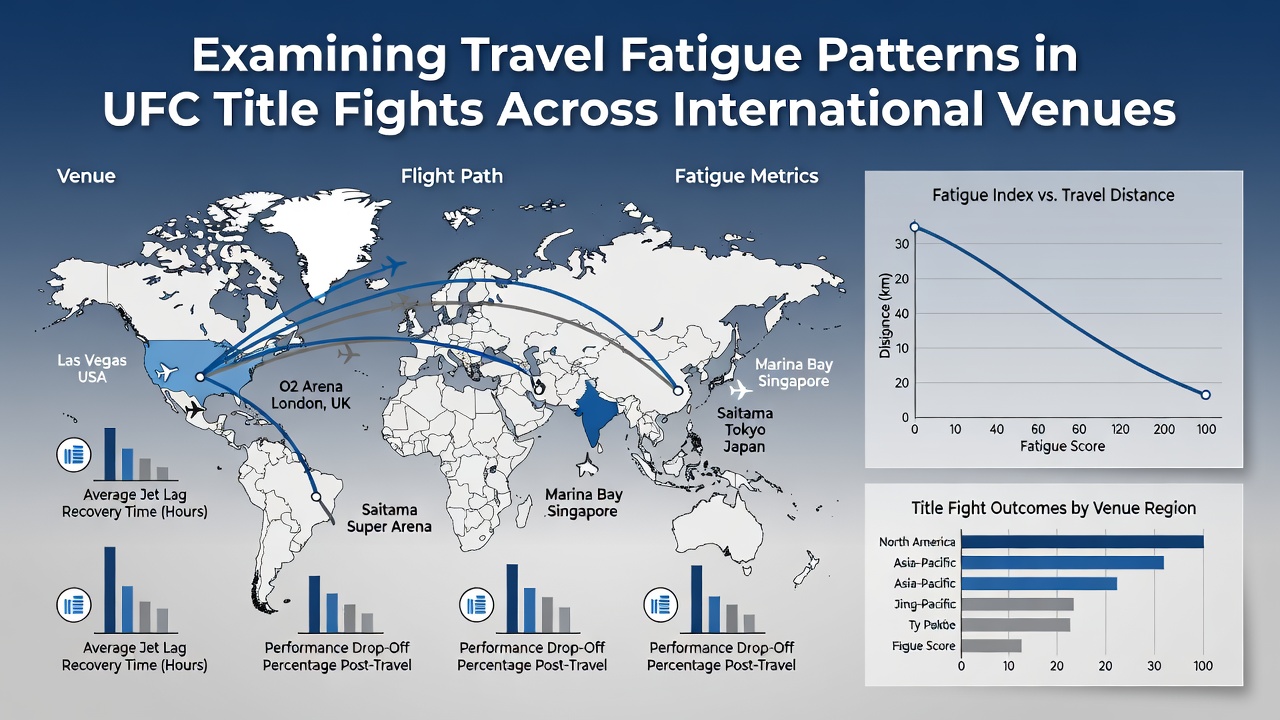
Eastward travel to Europe or the Middle East correlates with higher rates of late-fight fatigue, and evidence from heart rate recovery tests shows elevated resting rates persisting up to 96 hours after arrival in some cases. Westward journeys to Australia or New Zealand produce different profiles where fighters report greater difficulty maintaining high-intensity output in the championship rounds, although overall decision rates remain closer to domestic baselines once the third day of local training begins.
Case Examples from Recent International Title Cards
One welterweight title fight held in Singapore in 2023 featured a champion traveling from the United States who posted lower average power output on leg kicks during rounds two and three, and post-fight medical data indicated delayed lactate clearance consistent with incomplete jet lag recovery. A separate middleweight bout in Abu Dhabi two years later saw the challenger, arriving from Brazil, absorb more significant strikes in the fifth round after exhibiting slower footwork in earlier exchanges according to motion capture analysis.
Observers tracking these events compile multi-factor models that control for age, weight cut severity, and prior fight frequency, and the resulting regressions still attribute a statistically significant portion of variance to travel distance and direction. Preparatory camps now incorporate simulated time zone adjustments using light therapy boxes and scheduled meal shifts, yet complete mitigation remains elusive when the total flight time exceeds 12 hours.
Emerging Data Ahead of August 2026 Events
With the UFC confirming a title fight card scheduled for Tokyo in August 2026, performance analysts have begun modeling projected fatigue curves based on historical trans-Pacific travel logs, and preliminary simulations suggest that athletes departing from North American training bases may require 16 days minimum for optimal adaptation. Data from previous Japan-based events reveals that fighters who trained in local time zones for fewer than 11 days showed elevated markers of oxidative stress in blood samples drawn 24 hours before weigh-ins.
Regulatory bodies overseeing combat sports in Canada and the European Union have started requesting travel impact disclosures from promoters, adn these filings aim to establish baseline expectations for medical monitoring protocols at future international venues. Researchers continue to refine predictive algorithms that integrate flight duration, layover count, and individual chronotype to forecast which competitors face elevated risk profiles.
Conclusion
Patterns extracted from international UFC title fights demonstrate that travel fatigue influences early-round output, late-round endurance, and recovery timelines in measurable ways, while ongoing data collection supports refined preparation strategies for upcoming events including the 2026 Tokyo card. Continued monitoring by sports science teams across multiple continents provides the foundation for evidence-based scheduling decisions that account for these physiological realities.